If you’ve ever travelled abroad and swapped your money for another currency, congratulations — you’ve already participated in the forex market (even if you didn’t know it).
But here’s the thing: professional forex traders don’t just exchange money at airports for a holiday. They trade currency pairs every day to take advantage of price changes.
And in this guide, I’ll break it all down for you — in plain, simple language — so you’ll walk away thinking, “Hey, I actually get this now.”
 Every currency pair has two parts:
 Let’s say you believe the euro will strengthen against the dollar. You buy EUR/USD at 1.1000.
What Exactly Is a Currency Pair?
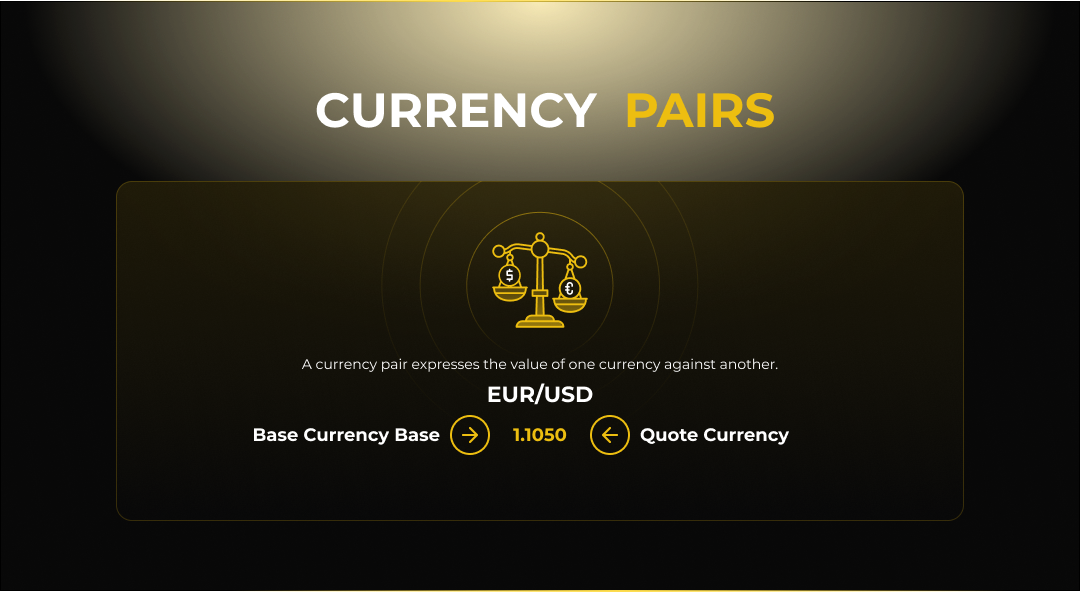
At its core, a currency pair is simply a way of expressing the value of one currency against another. Example: EUR/USD = 1.1050 means:- 1 euro (EUR) = 1.1050 US dollars (USD)
Base Currency & Quote Currency
Every currency pair has two parts:
- Base currency – the first currency in the pair (EUR in EUR/USD)
- Quote currency – the second currency in the pair (USD in EUR/USD)
- EUR/USD = 1.1050 → You need 1.1050 USD to buy 1 EUR.
The Three Main Types of Pairs
Think of currency pairs as three “families”:A. Major Pairs
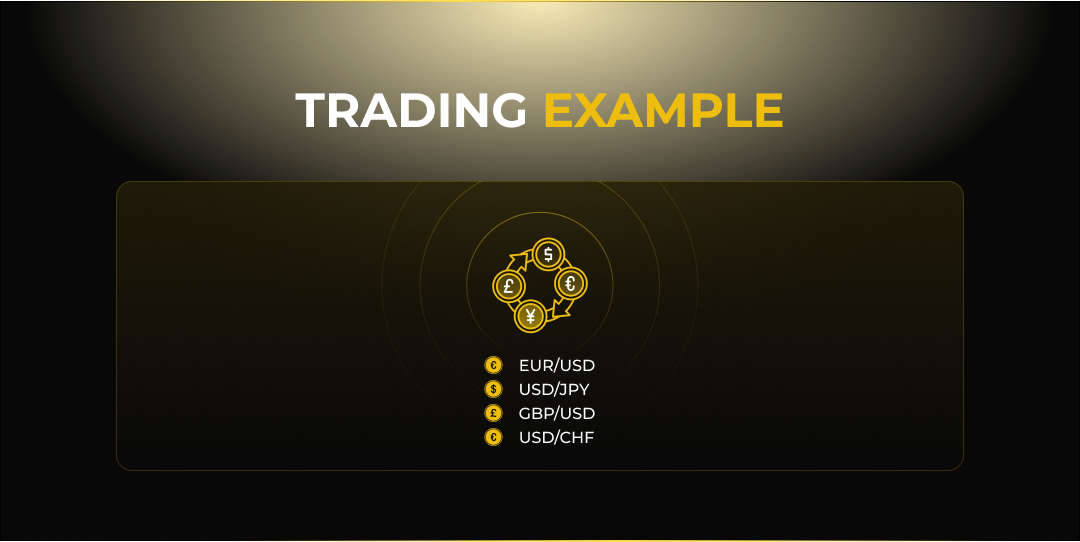
These are the most traded in the world — highly liquid, low spreads. They always include the US dollar (USD). Examples:- EUR/USD
- GBP/USD
- USD/JPY
Minor Pairs (Cross Currency Pairs)
These don’t include the US dollar but involve major world currencies. Examples:- EUR/GBP
- AUD/JPY
- GBP/JPY
Exotic Pairs
One major currency + one currency from a smaller/emerging economy. Examples:- USD/TRY (Turkish lira)
- EUR/ZAR (South African rand)
- USD/THB (Thai baht)
What Moves Currency Pairs?
The forex market isn’t random — prices move because of:- Economic Data Interest rate changes, inflation reports, GDP numbers, employment data — all can send prices flying.
- Politics & Geopolitical Events Elections, wars, trade agreements, sanctions — all shift investor confidence.
- Market Sentiment Risk-on (investors are confident) → money flows into riskier currencies (like AUD, NZD). Risk-off (investors are fearful) → money flows into safe-havens (like USD, JPY, CHF).
How Prices Are Quoted – Bid, Ask & Spread
When you open your trading platform, you’ll notice two prices for each pair:- Bid – The price you sell the base currency.
- Ask – The price you buy the base currency.
- EUR/USD Bid = 1.1048
- EUR/USD Ask = 1.1050
Understanding Pips
A pip is the smallest price change in most currency pairs — usually the 4th decimal place. Example: 1.1050 → 1.1055 = 5 pips. For JPY pairs, it’s the 2nd decimal place (USD/JPY: 145.50 → 145.55 = 5 pips).
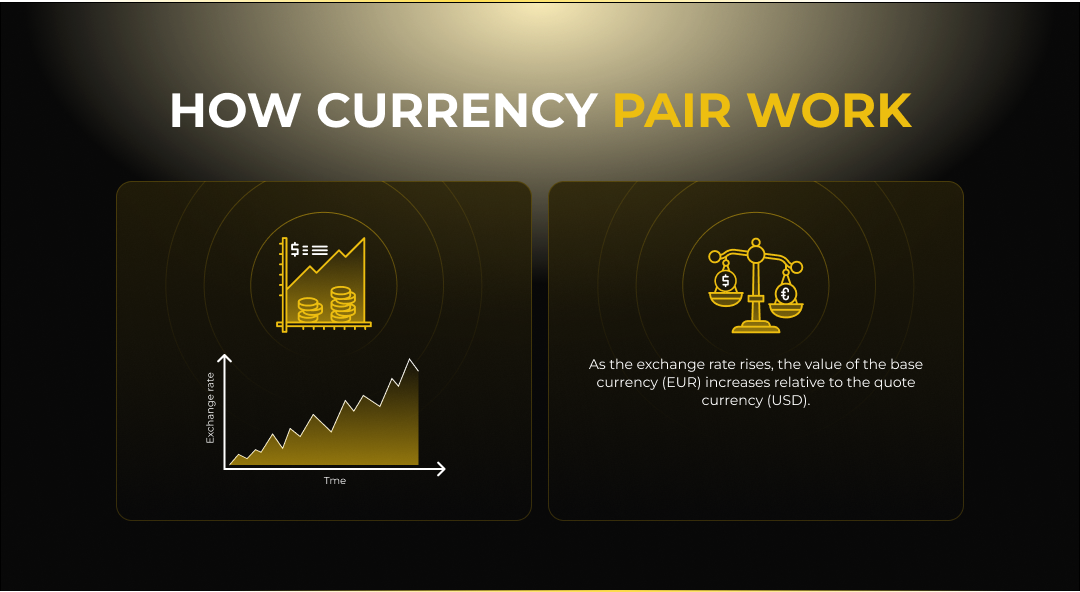
Let’s say you believe the euro will strengthen against the dollar. You buy EUR/USD at 1.1000.
- Price moves to 1.1050 → You gained 50 pips.
- If your position size was 1 standard lot (100,000 units), that’s $500 profit (because 1 pip ≈ $10 for this size in the EUR/USD pair).
Why Understanding Currency Pairs is Your First Step to Consistent Trading
A lot of beginners jump straight into indicators and strategies without fully grasping the foundation — currency relationships. But when you understand:- Which pairs move more during certain sessions
- How economic events impact them
- Which ones fit your style (steady majors or wild exotics)
Pro Tips for Mastering Currency Pairs
- Start with majors — learn market behaviour with less volatility before exploring minors and exotics.
- Track correlations — some pairs move together (EUR/USD and GBP/USD), others move opposite (EUR/USD and USD/CHF).
- Respect the spread — avoid trading exotic pairs with huge spreads unless you have a strong reason.
- Follow the news — sometimes it’s not the chart but the calendar that tells you what’s coming.