
Foreign Exchange
— better known as Forex — is the world’s largest and most dynamic financial market. Unlike a stock exchange that’s tied to one country, Forex is global, decentralized, and trades around the clock. But beyond the technical definition, Forex is really about one simple thing: exchanging money from one currency to another, with the goal of benefiting from changes in their value.
Think of it this way: whenever you travel abroad and exchange your home currency into the local one, you’ve already participated in Forex—just on a much smaller scale than banks, institutions, or professional traders do every second of the day.
Let’s break it down in plain language.
 Even if you’ve never placed a single trade in your life, Forex impacts you.
- Traveling abroad? You need currency exchange.
- Buying imported goods? Their cost is affected by exchange rates.
- Investing internationally?Forex determines how much your returns are worth when converted back.
- The Forex market is open 24 hours a day, five days a week, moving from Asia, to Europe, and then to North America before the cycle starts again.
- The market trades in pairs (EUR/USD, GBP/JPY, etc.), meaning you’re always buying one currency while selling another.
- With a daily trading volume of over $6 trillion, Forex is bigger than all stock markets combined!
What Drives Currency Prices?
Unlike a company stock, which moves based on earnings or news, currency values shift for broader reasons:- Economic health – Growth, inflation, and unemployment data shape expectations.
- Interest rates – Central banks (like the Federal Reserve or European Central Bank) can make a currency stronger or weaker depending on their policies.
- Geopolitical events – Elections, wars, trade agreements, or global tensions can move currencies in seconds.
- Market sentiment – Sometimes, it’s simply about perception. If investors feel the U.S. dollar is “safe,” they’ll flock to it in uncertain times.
 For traders, Forex offers something unique that most markets can’t match:
- It’s always moving, creating opportunities day and night.
- You can profit in both directions—when prices go up or down.
- It’s accessible: With online platforms, anyone can start small. This is why millions of traders, from professionals to hobbyists, find Forex attractive.
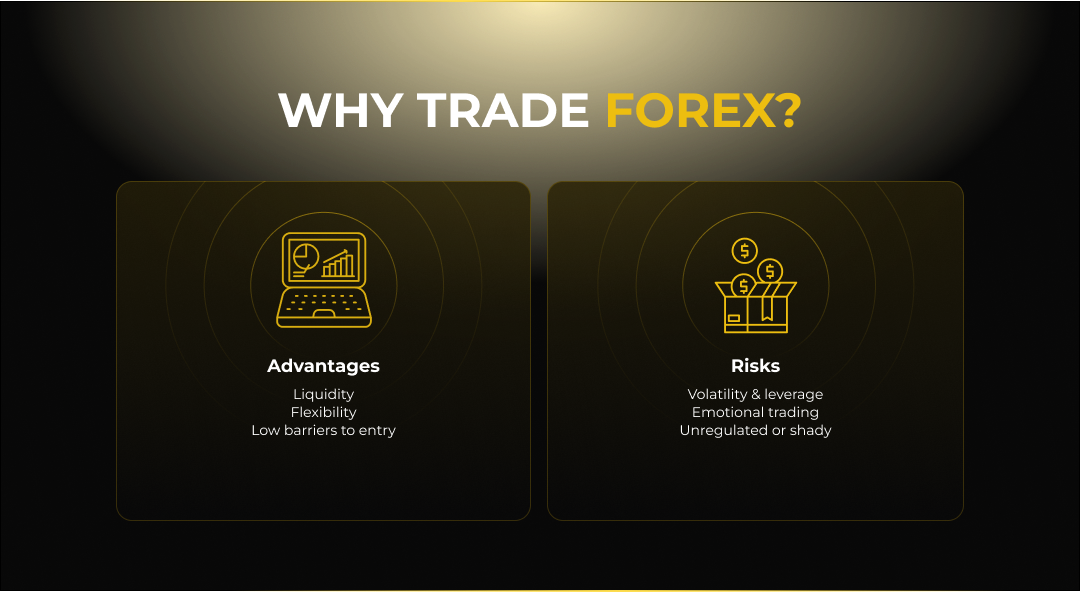
Advantages
- Liquidity – Easy to enter and exit trades due to high market volume.
- Flexibility – Trade part-time or full-time; the market is always open somewhere.
- Leverage – Control larger positions with smaller amounts of capital (though this is a double-edged sword).
- Low barriers to entry – You don’t need millions to participate; even small accounts can trade.
Risks
Of course, no opportunity comes without risks:- High volatility – Currencies can move fast, leading to quick losses if not managed.
- Leverage risk – While leverage amplifies profits, it can also magnify losses.
- Emotional traps – Greed, fear, and overconfidence can derail even smart strategies.
- Scams & poor brokers – Not all brokers are trustworthy, making education and due diligence essential.
Starting Steps (Inspired by a Friendly Mentor Style)
If you’re curious to begin, here’s a mentor-style roadmap:- Learn the basics – Don’t rush. Understand how pairs, pips, spreads, and charts work.
- Choose a reliable broker – Regulation and transparency matter more than flashy promises.
- Start with demo trading – Practice risk-free before putting in real money.
- Develop a strategy – Whether trend-following or range-trading, consistency is king.
- Risk management first – Decide how much you’re willing to lose before you trade.
- Keep emotions in check – Patience and discipline separate successful traders from the rest.
Real-World Example
Imagine you believe the Euro will strengthen against the U.S. Dollar. You buy EUR/USD at 1.1000.- If the price rises to 1.1200, you’ve gained 200 pips (a solid profit).
- If it falls to 1.0800, you’ve lost 200 pips.